The pharmaceutical sector is at a critical inflection point. For decades, decision-making in pharma R&D has been defined by long timelines, siloed teams, and the inherent complexity of science and regulation. These structural barriers cost pharmaceutical companies millions of dollars across their portfolios each year.
Compounding these internal challenges, the external world is moving faster than ever. Patient needs are evolving rapidly, regulators are adapting at speed, and the pressure to bring therapies to market faster has never been greater.
At the same time, the pace of digital transformation, AI adoption, and workforce change is accelerating. AI adoption in particular is already showing tangible impact on molecule design, trial execution, and regulatory documentation, fundamentally reshaping how pharma R&D teams make critical decisions.
Yet the structural barriers behind those old constraints remain. Siloed teams slow down decisions and obscure trade-offs. Data is growing more complex as workforce turnover threatens the continuity of knowledge. Without a systematic way to capture and reuse learnings, organizations face widening knowledge gaps that make them less resilient.
The paradox is clear: pharmaceutical companies need to move faster than ever, yet the very processes guiding their decisions are slowing them down. To close that gap, industry leaders are turning to Decision Intelligence, a new class of software that integrates human expertise, data, and AI to enhance the speed, quality, consistency, and impact of enterprise decisions.
How Decision Intelligence Streamlines R&D
In drug development, R&D teams are often siloed and working with disconnected data sources. Critical insights are often not shared across teams, and decisions are made with an incomplete picture. This results in teams unknowingly repeating work already completed elsewhere in the organization, wasting time, budget, and momentum.
R&D leaders are constantly navigating hard tradeoffs: speed versus confidence, portfolio breadth versus focus, and scientific optionality versus cross-functional alignment. Without clear frameworks to balance these tradeoffs, decisions stall, or worse, move forward without shared conviction.
As pharmaceutical companies adopt AI tools across R&D, these coordination challenges only intensify. Solving these problems requires more than better communication or individual process improvements.
Pharmaceutical companies need a new operating model for decisions, one that eliminates duplication by making knowledge visible, enables systematic trade-offs, and establishes unambiguous accountability. This is where Decision Intelligence comes in.
Decision Intelligence captures every decision and the reasoning behind it in one centralized place. This makes risks visible early across teams through systematic processes that identify and quantify them.
Teams can track decisions with real-time visibility into progress and key gaps. Even when employees leave, the system retains their knowledge, creating a living knowledge base that feeds back into AI-powered insights.
Decision Intelligence provides decision templates and clear workflows for all decision types. This enables teams to define and communicate trade-offs explicitly and signal when to escalate versus delegate a decision.
For example, R&D teams in pre-clinical studies can coordinate their efforts and align on priority studies using decision templates. These templates ensure all teams work from the same framework, eliminating duplication and ensuring critical insights flow across teams and therapeutic areas.
Decision Intelligence also establishes clear roles for every decision: who drives it, who contributes, who approves, who stays informed. This reduces delays, strengthens compliance, and maintains control, visibility, and alignment, even when teams delegate across complex structures.
Impact Across the Pharmaceutical Value Chain
The implications extend across the entire pharmaceutical value chain. In early discovery and pre-clinical research, Decision Intelligence enables more rigorous stage gates by synthesizing efficacy and safety insights alongside market dynamics.
During clinical development, it helps prioritize resources with greater precision so the highest-value candidates move forward. In later stages like regulatory submission, manufacturing, commercialization, and post-market surveillance, the same framework provides alignment, visibility, and resilience.
The cumulative effect is powerful. Teams across therapeutic areas gain clarity and alignment. Shifting priorities are managed with transparency. Risks, both foreseen and unforeseen, are tracked and mitigated systematically. And when course correction is required, as it inevitably will be, the organization can realign faster and with greater confidence.
Decision Intelligence in Action: A Pharma R&D Case Study
One global pharmaceutical company faced a critical challenge: evaluating multiple developmental drug candidates to determine which should advance to the next phase of clinical trials. The decision required input from six functional groups and had financial implications in the millions of dollars.
The existing decision-making process was complex and time-consuming. Without an efficient approach, decision-making was delayed, resulting in missed opportunities and potential financial losses.
The company partnered with Cloverpop to deploy a comprehensive decision Intelligence workflow that established clear guidelines and criteria for evaluating drug candidates.
Using Cloverpop's AI powered Decision Intelligence Platform, all six functional groups provided input and feedback in a structured manner. The solution enabled teams to consider all key clinical trial requirements, ensuring informed decision-making with full cross-functional alignment.
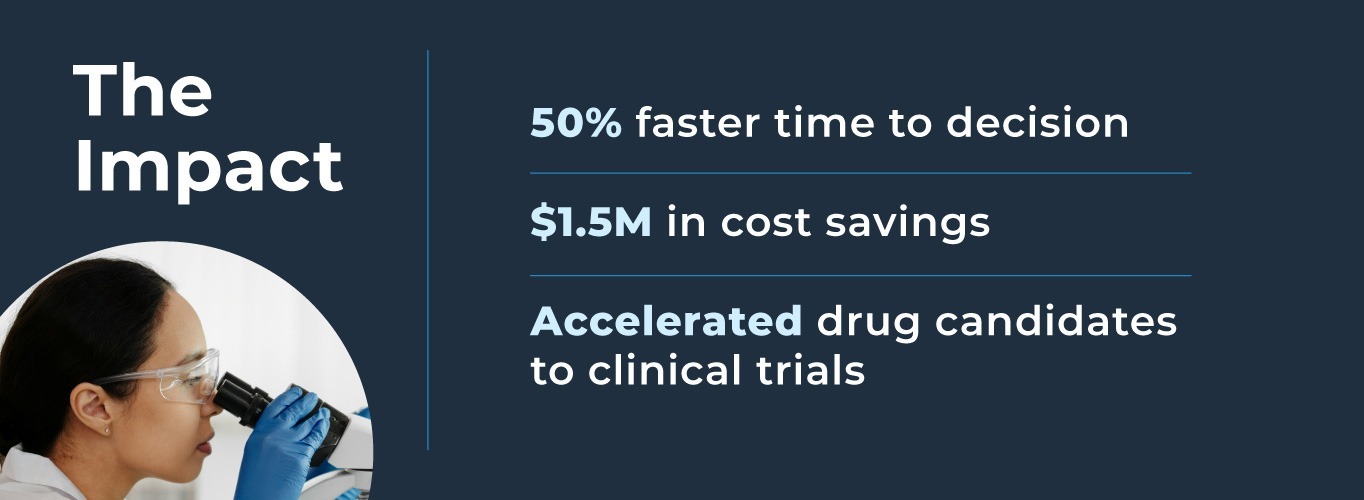
Time to decision improved by 50%. The streamlined process enabled efficient coordination among multiple teams, reducing delays and accelerating the decision-making timeline.
The company brought promising drug candidates to clinical trials sooner, delivering an estimated $1.5 million in cost savings and capturing market opportunities more quickly.
Transform Pharma R&D with Decision Intelligence
For leading pharmaceutical companies, the message is clear: Decision Intelligence is not a tool but a foundation. It helps organizations institutionalize best practices, strengthen governance, and embed AI-driven feedback loops that continuously improve decision quality.
Competitive advantage in the next decade won't come solely from scientific breakthroughs. It will come from the ability to make better, faster, and more coordinated decisions, consistently and at scale.
In an industry defined by complexity and speed, the companies that embrace Decision Intelligence will set the pace.
Cloverpop is the first end-to-end Decision Intelligence platform built for the enterprise. We help Fortune 100 pharmaceutical companies accelerate decisions by up to 4x while reducing the risk of negative outcomes by 50%, according to a joint Cloverpop and Stanford study.
Our platform makes risks visible, trade-offs explicit, and accountability clear, exactly what pharma R&D teams need to navigate this current reality.