

Cloverpop’s Decision Pulse Report: Full Insights Now Live
The State of Decision-Making 2025: Effectiveness, AI, and What's to Come in 2026
We asked leaders across industries how decisions got made in 2025 - what worked, what got in the way, and what’s shifting for 2026.

Fast Stats From the Field
6.5%
of organizations say they were “very effective” at decision-making
Top Barriers To Better Decisions
- Misalignment
- Approvals
- Risk Aversion
52%
report incremental improvements in decision speed, but only 3% saw major gains
#1 Priority
for 2026: Improving decision quality
How Teams Really Made Decisions in 2025
How Effective Were Decisions in 2025?
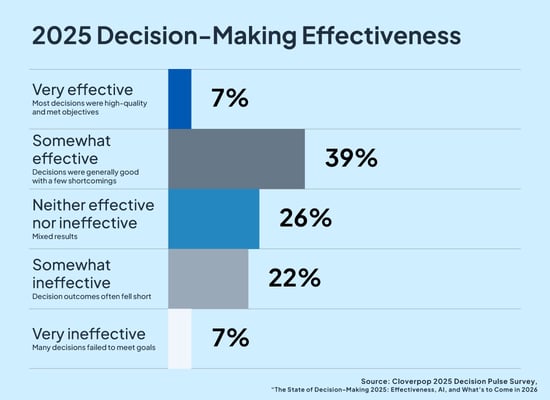
Teams are still working toward consistent, high-quality decision-making. Only 6.5% of organizations rated themselves as very effective. Nearly half fell into the "somewhat effective" middle, signaling widespread room for improvement.
The reality: incremental improvements to ad-hoc processes won't close this gap. Enterprise decision-making needs a systematic approach, one that treats decisions as organizational data that can be tracked, learned from, and improved over time.
What Helped Teams Improve and What Didn’t?
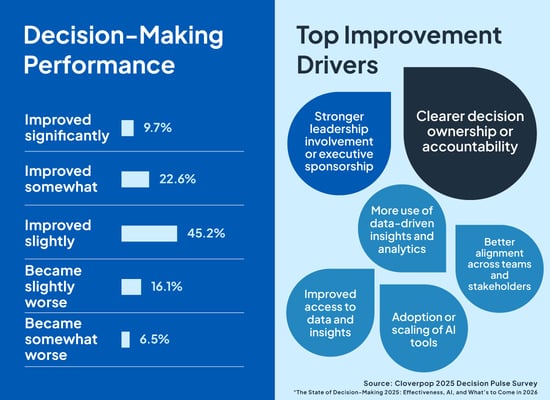
Most teams saw only slight improvement year over year.
🔹 45% reported slight gains in decision performance
🔹 Just 10% saw significant progress
Top improvement drivers? AI tools, clearer ownership, and better access to insights. But the gains were incremental, not transformational.
Why the gap? These elements work when they're coordinated — when technology, process, and ways of working come together at the organizational level with a structured approach.
Scattered improvements don't create lasting change.
The Top Barriers to Better Decisions
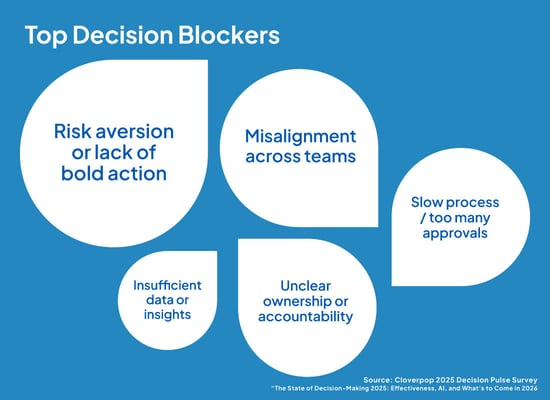
Even as processes evolved, some classic blockers persisted. Teams cited risk aversion, misalignment, and slow processes as the biggest inhibitors to effective decision-making. This suggests cultural and structural issues still outweigh tooling gaps.
The pattern is clear: these aren't isolated problems. Misalignment and slow processes are coordination failures. Risk aversion signals lack of confidence in available information. Enterprises need a systematic approach to decision-making, one that delivers speed, quality, and confidence.

2026 Priorities: What Teams Are Focusing On Next
Looking ahead, quality beats speed. Improving decision quality topped the list of 2026 priorities, followed by speed, alignment, and governance.
The insight: these aren't separate challenges. Quality, speed, and governance all stem from how decisions are made. Enterprises need to take a holistic approach to decision-making, fixing the underlying system rather than optimizing quality vs. speed individually.
AI Helped With Insights - But Workload Relief Is the 2026 Goal
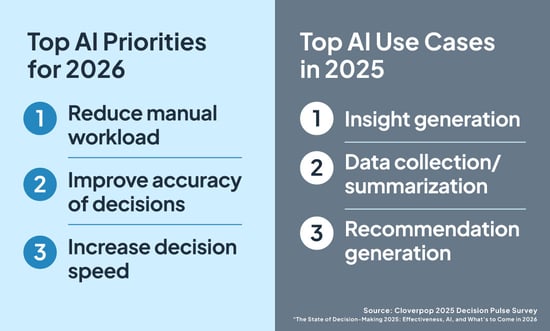
When asked what they want from AI in 2026, reducing manual workload topped the list (36%). And it's already happening: in 2025, AI was most commonly used for insight generation (58%) and data summarization (55%), the foundational work that's been consuming I&A time.
The shift is already happening. As AI handles more data synthesis and insight generation, I&A professionals must move up the value chain, from producing insights to shaping decisions.
AI Advised More Than It Acted, and Trust Is Still Evolving
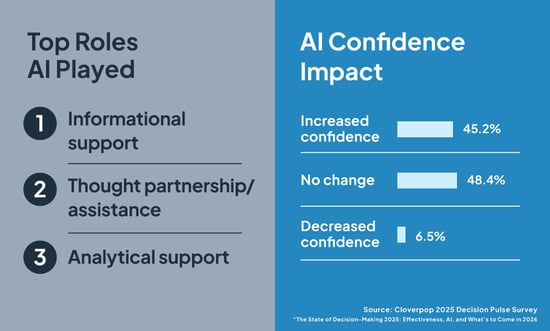
In most organizations, AI agents acted more like assistants, playing a supporting role:
🔹61% used it for informational input
🔹45% as a thought partner
🔹Only 3% reported autonomous AI decisions
When it came to team confidence, the impact was modest:
45% felt more confident with AI, but 48% saw no change.
This aligns with a broader pattern: disjointed AI tools deployed at various points in the decision-making process. Companies are waking up to the fact that this approach isn't driving real value.
The next phase will be a shift toward integrated AI that works systematically across the decision-making process, driving both measurable impact and confidence.
AI’s Role: Expanding, but Still Uneven
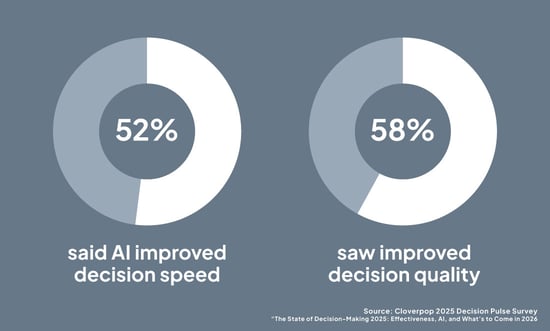
AI showed up, but the benefits were largely incremental, not transformational:
🔹 52% said AI improved decision speed
🔹 58% saw improved decision quality
Yet only 3% reported major speed gains, and many flagged trust, data quality, and poor integration as blockers. The potential is there, but execution lags behind.
Enterprises can only realize AI's full potential when they take an approach that connects the right data to the right people, transparently, across the entire decision-making process. The gap between modest and major gains isn't about AI's capabilities, it's about how systematically it's deployed.
Who Benefited Most from AI?
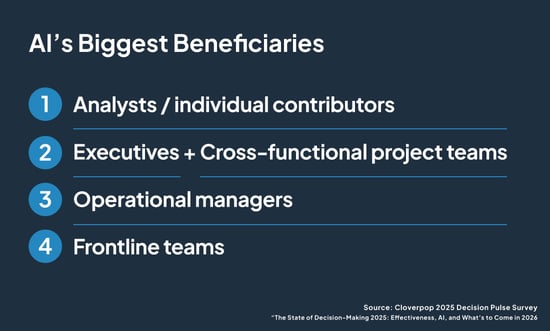
AI impact wasn’t just felt at the top. While executives and managers saw benefits, analysts and individual contributors ranked highest. This points to AI’s utility in day-to-day execution and shared decision ownership.
This validates a crucial shift: empowering the people closest to the decision. When frontline teams have the right tools, data, and context, they can make better decisions faster, while leadership maintains visibility and oversight.