
What is Decision Intelligence?
The short answer
Decision Intelligence is the discipline of structuring, tracking, and improving enterprise decisions through AI and human collaboration. It creates a system of record for every important decision a company makes, capturing what was decided, why, by whom, and what happened, so the organization learns from each decision and improves on the next one.
Table of Contents
- What Decision Intelligence actually is, in plain terms
- Why AI alone isn't creating meaningful enterprise value… yet
- Decisions as a first-class business object
- What Decision Intelligence isn’t
- The Decision-Back™ methodology
- The practical AI unlock most enterprises are missing
- The framework for driving AI Agent value
- What Decision Intelligence looks like in practice
- Glossary of Decision Intelligence Terms
- Frequently Asked Questions
- Where to start with Decision Intelligence
What Decision Intelligence actually is, in plain terms
Every enterprise makes tens of thousands of important decisions a year. Almost none of them get written down.
Decision Intelligence changes that by recording decisions the way accounting records transactions, project management records tasks, and CRMs record customer interactions. Decision Intelligence gives an organization a place to put knowledge that today lives in meeting rooms, email threads, DMs, and executive intuition. Critically, it treats decisions as business objects that AI can now help improve.
AI changes what's possible. Decisions haven't been recorded historically because it was tedious work no one wanted to do, resulting in records that few would refer back to. Companies would rather have another meeting than write down what was decided in the last one. That constraint is dissolving. AI can now capture, structure, and improve decisions in real time, but only if there's a system for it to write into. And then AI can use that information to help improve the next decision.
That's what a Decision Intelligence platform is: the system.
Why AI alone isn't creating meaningful enterprise value… yet
Most enterprise AI investment right now is focused on the wrong lever.
The bulk of it goes toward efficiency and cost reduction: automating repetitive knowledge work, processing forms without humans in the loop, generating first-draft content faster than a person could. Cost reduction is real value. It's also, for most industries, the least strategically important lever a company can pull.
Pharma companies don't win by being the lowest-cost pharma company. They win by making the best R&D decisions. CPG brands don't win on cost. They win on innovation and brand-building decisions. Financial services firms don't win on operational efficiency alone. They win on capital allocation decisions.
The strategic commercial levers (growth, innovation, distribution, brand, differentiation) are all downstream of decisions. And AI isn't smart about decisions. Not yet.
“Bain & Company research has shown that the effectiveness of a company's decision-making processes predicts roughly 95% of its relative business performance. Rank any set of competitors by how well they make decisions, and you'll be right 95% of the time about who outperforms whom.”
— Bain & Company, Decision Effectiveness Study
AI can transform decision-making. Everyone senses this is true. What no one has had until now is a way to operationalize it.
Decisions as a first-class business object
Once decisions exist as structured, tracked entities in a system of record, three things become possible for the first time.
AI has somewhere to write
When a chat interface like Claude, ChatGPT, or Copilot is connected to a Decision Intelligence platform, it can identify decisions that need to be made, kick them off, invite the right people, capture the decisions made, and log the outcomes. Ask Claude "are there any decisions I should be paying attention to?" and if it's connected to your DI platform, it can look through your inbox, your calendar, and your project channels, and surface real answers. Because it now knows what a decision is: what structure it has, what questions it requires, who needs to sign off, and what outcome to track.
Tacit knowledge becomes explicit
Most of what happens inside a company today never leaves the meeting it happened in. Someone who wasn't in the room can't easily learn from a decision that was made, either because there's no record, or because reading three months of meeting notes to find one relevant decision is impractical. When decisions are structured data, AI can find the relevant ones in seconds. The company gets institutional memory it didn't have before. And AI can use this information, too, at massive scale.
Decisions can be templatized and improved
After a company has made seventy-five similar decisions (say, seventy-five architecture decisions in the IT organization), the Decision Intelligence system can identify the best patterns across them, codify them into a template, and give the next person making that decision the full benefit of the previous seventy-five, along with connections to all the people and data involved. The next decision is faster and better, and it feeds back into the template. Decision quality compounds.
None of this is possible without an AI-powered Decision Intelligence platform. And every part of it becomes possible with one.
What Decision Intelligence isn’t
The term is popular enough now that it's being applied to nearly everything AI-adjacent. Most of what gets labeled Decision Intelligence isn't. The clarifying question is simple:
Does it have an explicit decision object at its center: a structured record of the question being decided, the alternatives, the people involved, the governing logic, the information used, what was chosen, and what happened afterward?
If yes, it’s Decision Intelligence. If no, it isn't. Here's how that plays out against the most common lookalikes:
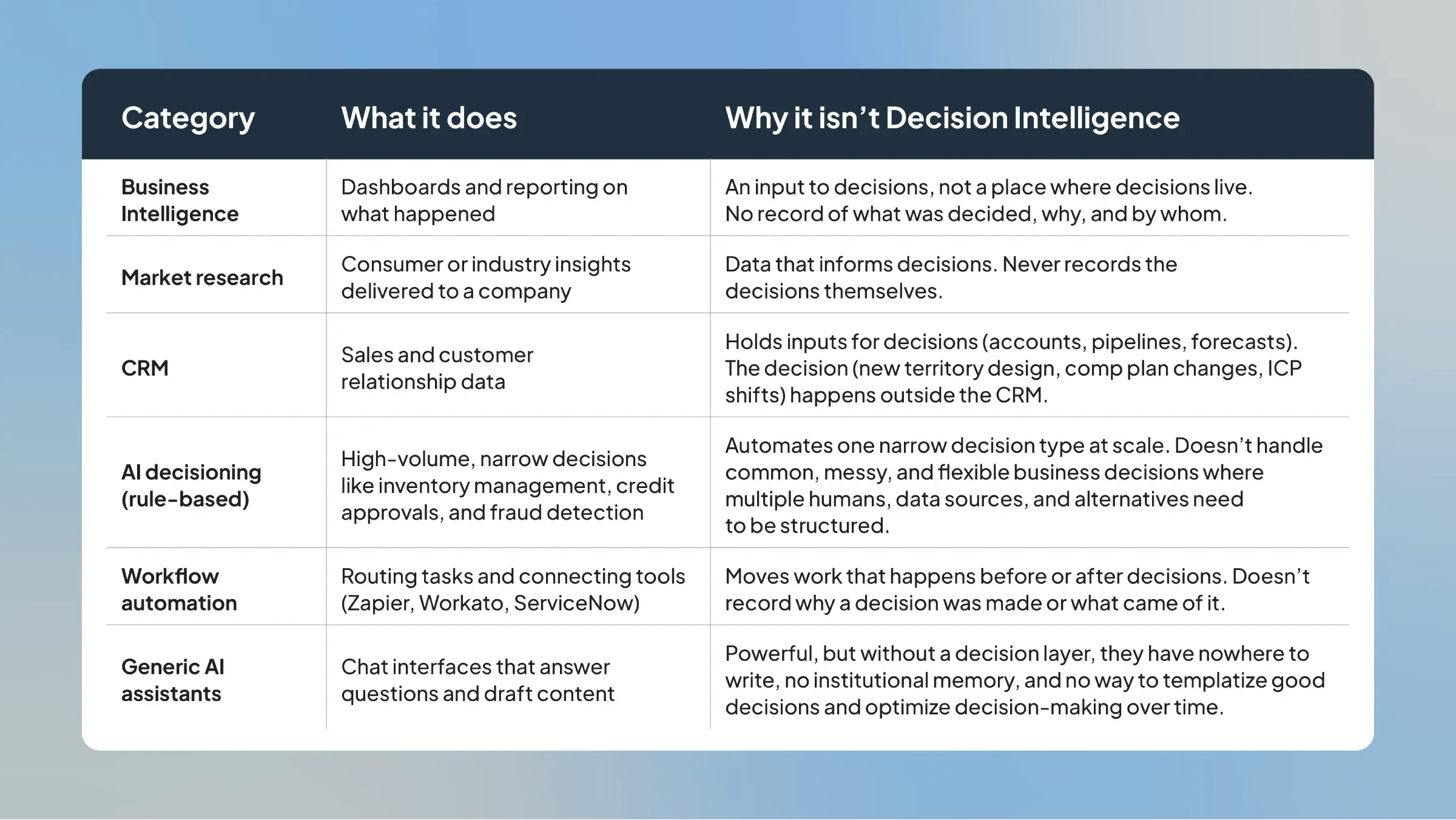
Each of these is a useful adjacent tool. None of them is Decision Intelligence.
The Decision-Back™ methodology
The most important shift Decision Intelligence enables is a change in how we think.
Decision-Back™ is the practice of starting with the important decisions a company, team, or individual needs to make and working backward from there. What information do those decisions need? Who should be involved? What process should we use? What investment does this decision warrant?
Executives have known for decades that decision quality drives outcomes. What they haven't had is a way to make Decision-Back thinking real. Historically, “improve our decision-making” meant hiring smarter people, training them better, giving them more data, and running more offsites. All incremental, and all hard to measure.
With a Decision Intelligence platform in place, Decision-Back becomes operational. When leadership identifies the most impactful decisions their organization makes (the ones that will move the business the most), those decisions can be codified into templates, embedded in the platform, and improved measurably over time. The team learns from every instance. The template gets better. The next decision benefits from everything the last one taught the system.
This is what makes Decision-Back implementations of Decision Intelligence different from a workshop or a whiteboard exercise. It's the operating model, made concrete in software.
The practical AI unlock most enterprises are missing
Here's the part that changes how enterprises should think about AI adoption.
Right now, the knowledge workers getting real value from AI are the tip of the spear. The people willing to write careful two-paragraph prompts, iterate, and think about how to get the most from a model. That's a small percentage of any workforce. Most people write one-sentence prompts and use whatever they get back from AI.
That's not going to change. Most brand managers, sales managers, R&D leaders, and category planners are not going to become prompt engineers. They shouldn't have to.
A Decision Intelligence platform solves this by writing the prompt for them. When someone asks a simple, one-sentence question about a decision, “Should we expand into the fresh dog food category?” or “What's our supply risk on this quarter's launches?”, the DI platform hands the LLM everything it needs to answer well: the relevant decision templates, the people involved, the data sources, the historical decisions that shaped the current context.
The user asks a normal question. They get a decision-grade answer, informed by the company's full institutional knowledge, governed by the company’s policies, that also creates more knowledge to benefit the next decision.
This is the democratization moment for enterprise AI. Not everyone becomes a prompt engineer, but everyone becomes a better decision-maker.
The framework for driving AI Agent value
Companies are building thousands of AI agents. Some analyze market research. Some monitor financial risk. Some answer questions about supply chains, customers, or competitors.
Each agent can be useful on its own. The harder question is how all of those agents actually help a company make better decisions.
That’s where Decision Intelligence comes in.
Instead of starting with the agents and asking where to use them, Decision Intelligence starts with the decisions that matter and works backward. What does this decision need to know? Which agents can help? Which people need to weigh in? What should happen next?
Imagine a company has one agent that analyzes consumer research, another that assesses currency risk, and another that tracks commodity prices. Those agents become much more valuable when their work is connected to the decisions they were built to support: which products to launch, where to manufacture them, how to price them, and how to promote them.
Decision Intelligence provides the structure that brings those agents, the relevant data, and human judgment together around the decision itself. It also captures what was decided and what happened afterward, so the system can learn.
What Decision Intelligence looks like in practice
Cloverpop’s customers (Fortune 100 companies across CPG, pharmaceuticals, financial services, and technology) are applying Decision Intelligence to concrete, measurable outcomes:
- A leading CPG company reduced its supply chain change-request process from weeks to days, unlocking $19M in finance-validated value in two months.
- A Fortune 50 technology company brought order to its IT architecture governance and captured $35M in tech-debt reduction in year one.
- A 100-person Insights & Analytics team at a global consumer brand cut costs by 30% while proving impact for the first time.
- The world’s largest beer company identified the attributes that actually drive assortment decisions and delivered a 3.5% sales uplift.
- A pet food company brought confidence to its expansion strategy in a $900M projected fresh dog food segment by structuring its innovation decisions.
Each of these came from applying Decision Intelligence to a specific class of decisions that had previously relied on tribal knowledge and meeting-by-meeting improvisation.
Glossary of Decision Intelligence Terms
Decision Intelligence: The discipline of structuring, tracking, and improving enterprise decisions using AI and human collaboration.
The Decision Layer: The architectural layer of the enterprise IT stack where data, AI, and human expertise converge to produce decisions. The decision layer is the connective tissue between analytics and business outcomes: this is where AI creates value. A Decision Intelligence platform is the software that operationalizes this layer.
Decision Graph: The semantic layer that maps how an organization thinks and decides (the decision logic, owners, inputs, and dependencies) as structured knowledge.
Decision System of Record: The enterprise source of truth for decisions. Captures what was decided, why, by whom, when, and what happened afterward.
Decision Playbook: A reusable, structured decision template that codifies high-quality decision-making logic. Once a company has made a certain decision well seventy-five times, the playbook lets the next person benefit from all seventy-five.
D-Sight™: Cloverpop’s proprietary agentic decision engine, grounded in decision graphs. Turns enterprise data into decision-ready recommendations.
Decision-Back™: The methodology of starting with the important decisions a company needs to make and working backward to design the people, process, technology, and AI investments around them.
DecisionIQ™: A nine-dimension diagnostic that benchmarks an organization’s decision-making quality against industry peers.
Decision AI Assistants: Always-on AI agents that anticipate issues, shape decisions with contextual intelligence, and orchestrate the work of getting decisions made.
Human^AI: Cloverpop’s framework for routing decisions between human stakeholders and AI agents in structured workflows.
Agentic Decision Intelligence: AI systems that operate on top of decision graphs to automate parts of the decision process while keeping humans accountable for the choices that matter.
Frequently Asked Questions
What is Decision Intelligence?
Decision Intelligence is the discipline of structuring, tracking, and improving enterprise decisions through AI and human collaboration. It creates a system of record where every important decision is captured (what was decided, why, by whom, and what happened) so the organization learns from each decision and gets better at the next one.
What is the Decision Layer?
The Decision Layer is the architectural layer of the enterprise stack where data, AI, and human expertise converge to produce decisions. It sits between analytics systems (which describe what happened) and business outcomes (what a company does about it), turning AI capability into decisions with owners, rationale, and tracked outcomes. A Decision Intelligence platform like Cloverpop is the software that operationalizes this layer.
How is Decision Intelligence different from Business Intelligence?
Business Intelligence reports on what happened. Decision Intelligence structures the decisions that happen next. BI describes data; DI orchestrates AI agents, human stakeholders, and decision logic to produce recommendations and capture outcomes. A dashboard is an input to a decision. The decision itself doesn’t live in the dashboard.
Is Cloverpop a Decision Intelligence platform?
Yes. Cloverpop is the enterprise Decision Intelligence platform. It provides the Decision System of Record, the Decision Graph, the D-Sight™ agentic decision engine, and the Decision-Back™ transformation methodology that Fortune 100 companies use to structure and improve their most important decisions.
What is a Decision Graph?
A Decision Graph is a structured, machine-readable map of how an organization thinks and makes decisions. It codifies decision logic, ownership, inputs, and dependencies so that both humans and AI can act on them consistently.
Who typically leads Decision Intelligence adoption inside a company?
Adoption is most commonly led by Chief Data & AI Officers, Chief Strategy Officers, or senior leaders in Insights & Analytics or IT, but the biggest impact usually comes when it’s championed jointly by a function head (SVP of Supply Chain, SVP of Insights) and the CIO or CDO.
How is Decision Intelligence different from AI decisioning?
AI decisioning typically refers to rule-based or model-based systems that automate high-volume, narrow decisions like credit approvals or fraud detection. Decision Intelligence handles the messier, more strategic decisions where multiple humans, data sources, and alternatives need to be structured before a good decision can be made, and where the outcome needs to be captured for organizational learning.
What kind of ROI do enterprises see from Decision Intelligence?
Documented outcomes across Cloverpop’s Fortune 100 customer base include $19M in finance-validated value in two months (CPG supply chain), $35M in tech-debt reduction in year one (Fortune 50 IT), 30% reduction in analytics function cost, and 3.5% sales uplift. Typical implementations show 10x faster decision cycles and 15x ROI.
What’s the difference between Decision Intelligence and workflow automation?
Workflow automation moves work. Decision Intelligence structures the choices that shape work. Zapier or ServiceNow can route a task to the right person; Decision Intelligence tells you what decision that task supports, who should weigh in, what information they need, and captures what actually got decided.
Does Decision Intelligence replace human judgment?
No. It structures and augments human judgment so it can be captured, compared, and improved. The point isn’t to remove humans from decisions; it’s to give humans the full context, options, and institutional knowledge they need to decide well, and to capture the outcome so the next decision benefits.
What is Decision-Back™?
Decision-Back™ is Cloverpop’s methodology for AI transformation. Rather than starting with “where can we use AI?”, it starts with “what decisions drive the most value in this organization?” and works backward to design the AI portfolio, operating model, and technology investments around those decisions.
Where to start with Decision Intelligence
If you’re evaluating whether Decision Intelligence fits your organization, here are three practical starting points:
Take the DecisionIQ™ benchmark. Nine dimensions, scored against your industry cohort. Gives you a diagnostic on where your decision-making processes are strong and where they’re leaking value.
Run a Decision Scan. Map the decisions in one function (supply chain, brand marketing, R&D) that materially drive business performance. Identify which of them are running on tribal knowledge and which have real support.
See the Decision Intelligence platform. Explore how Cloverpop is helping Fortune 100 enterprises turn AI investment into decision-grade business outcomes.